How to Calculate Wind Speed: Formula, Examples, Units and Conversion Guide
Wind is constantly changing. One moment it may feel like a gentle breeze, and a few minutes later, the same location may experience much stronger gusts. Understanding wind speed helps us make sense of weather reports, plan outdoor activities, and work safely in situations where moving air matters.
But how do you calculate wind speed? The answer depends on what information you have. If you know the distance and time, you can use a basic speed formula. If you want to measure the actual wind conditions at a location, an instrument such as an anemometer is a better choice.
In this guide, we'll walk through the formulas, practical examples, common measurement units, and wind speed conversions. We'll also explain the Beaufort scale and show how to interpret different wind readings.
If you need to convert measurements or calculate average speed, you can also try our Wind Speed Calculator.
1. What Is Wind Speed?
Wind speed describes how quickly air moves through the atmosphere. It is usually measured over a particular period and expressed in units such as miles per hour, kilometres per hour, or metres per second.
For example, a weather report showing 15 mph means the wind is moving at a measured speed of 15 miles per hour.
Wind speed information is useful in several areas:
-
Weather forecasting and meteorology
-
Aviation and marine navigation
-
Construction and site safety
-
Wind energy planning
-
Agriculture and environmental monitoring
-
Sailing, camping, and outdoor sports
One important distinction: wind speed and wind direction are not the same. Speed tells us how fast the air is moving, while direction describes where the wind is coming from in standard weather reporting.
2. How to Calculate Wind Speed: The Basic Formula
The basic formula for calculating speed is:
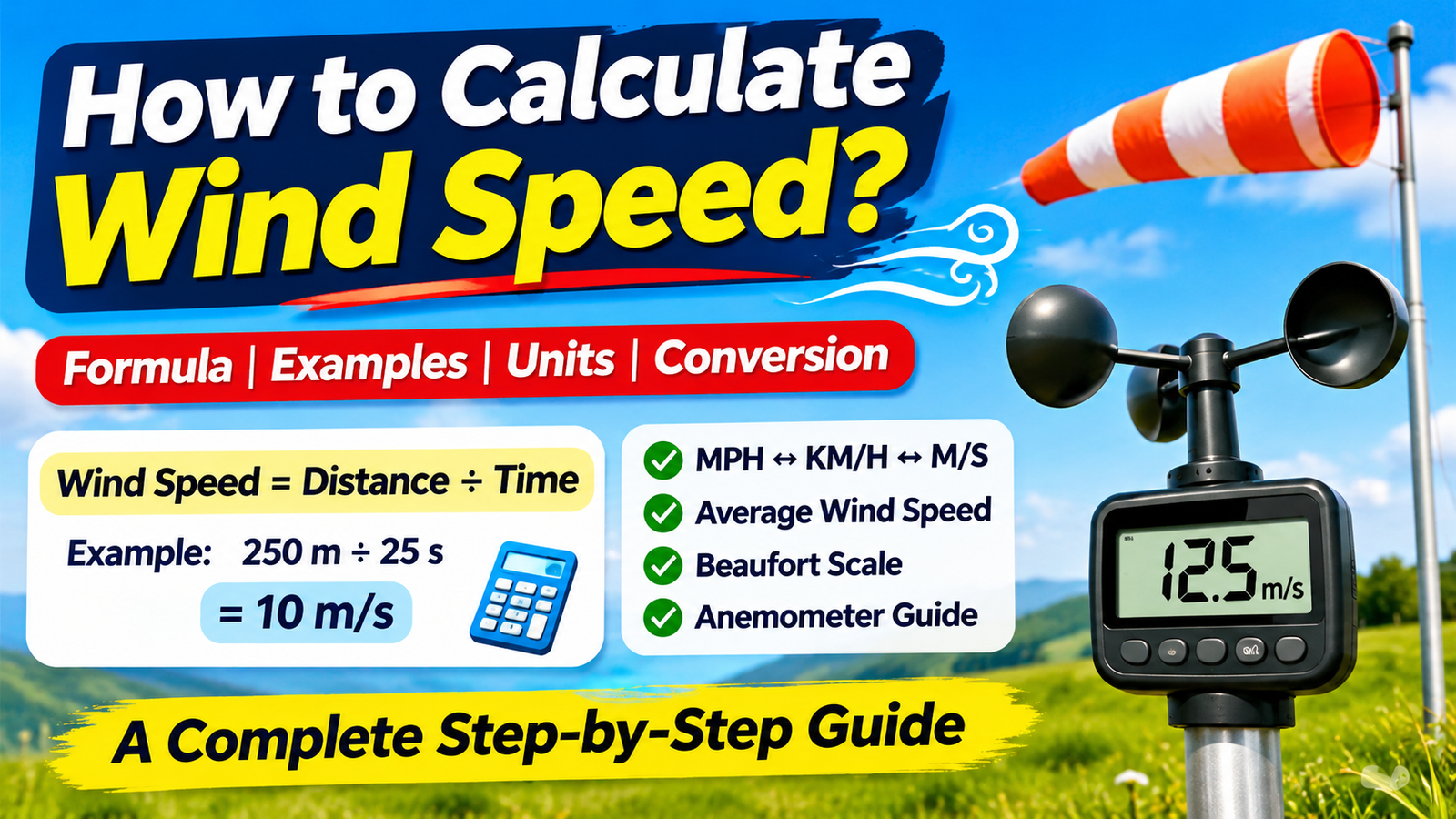
Speed = Distance ÷ Time
Here:
-
Speed is the rate of movement.
-
Distance is the length travelled.
-
Time is the duration of travel.
For example, suppose a moving object covers 100 metres in 10 seconds.
Speed = 100 ÷ 10
Average speed = 10 metres per second (m/s)
This formula is useful when distance and time are known. However, it is important not to confuse this mathematical calculation with a direct measurement of wind at a particular location. Actual wind conditions are usually measured using an anemometer.
3. Calculating Average Speed Using Distance and Time
When you have a known distance and the time taken to cover it, calculating average speed is straightforward.
Follow these steps:
-
Identify the total distance.
-
Record the time taken.
-
Make sure the distance and time units are compatible.
-
Divide the distance by the time.
Example 1: Distance in metres
Suppose the distance is 250 metres and the time is 25 seconds.
Speed = 250 ÷ 25
Answer: 10 m/s
Example 2: Distance in kilometres
Imagine a distance of 6 kilometres is covered in 30 minutes.
First, convert minutes into hours:
30 ÷ 60 = 0.5 hours
Now calculate:
Speed = 6 ÷ 0.5
Answer: 12 km/h
These examples show how the distance-and-time formula works. For actual wind measurement, use a suitable instrument and follow the appropriate measurement procedure.
4. How to Measure Wind Speed With an Anemometer
An anemometer is an instrument specifically designed to measure wind speed. It is commonly used at weather stations and in scientific, environmental, and engineering applications.
Different instruments use different methods to measure airflow.
Common types of anemometers
Cup Anemometer
This instrument has small cups attached to rotating arms. Wind causes the cups to spin, and the rotation rate is used to determine wind speed.
Vane Anemometer
A vane anemometer uses a small fan or impeller to measure airflow. Many handheld models also include a directional vane.
Hot-Wire Anemometer
This type uses a heated wire. Moving air cools the wire, and the instrument measures the resulting change to estimate air velocity.
Ultrasonic Anemometer
An ultrasonic anemometer uses sound waves travelling between sensors to calculate wind speed. Many models can also measure wind direction.
How to take a wind speed reading
-
Choose an appropriate location with good exposure to the wind.
-
Set up the instrument according to the manufacturer's instructions.
-
Avoid placing it too close to walls, trees, or other obstacles.
-
Allow the instrument to stabilise if required.
-
Record the displayed speed and its unit.
-
Take additional readings if you want to understand how conditions change over time.
The location matters. A reading taken beside a building may differ considerably from one taken in an open area because nearby objects can disturb airflow.
5. How to Calculate Average Wind Speed From Multiple Readings
Wind rarely stays at exactly the same speed. Taking several readings can help you understand the conditions more clearly.
If readings are taken at equal time intervals, you can calculate their arithmetic average using this formula:
Average Speed = Sum of All Readings ÷ Number of Readings
Example 3: Average of four readings
Suppose your readings are:
-
10 mph
-
12 mph
-
14 mph
-
16 mph
Add the values:
10 + 12 + 14 + 16 = 52
Divide by the number of readings:
52 ÷ 4 = 13
Average wind speed = 13 mph
This method assumes that all readings use the same unit and are taken at equal intervals. If the time intervals differ, a time-weighted average may be more appropriate.
There is another detail worth remembering: when wind direction changes, simply averaging the speed values does not describe the overall movement of air. A vector average also considers direction.
6. Common Wind Speed Units
Wind speed can be expressed in several units. The preferred unit often depends on the country, industry, or type of measurement.
| Unit | Common use |
|---|---|
| Miles per hour (mph) | Everyday weather reporting in the United States |
| Kilometres per hour (km/h) | Weather reporting in many countries |
| Metres per second (m/s) | Scientific and technical measurements |
| Knots (kn) | Aviation and marine navigation |
| Feet per second (ft/s) | Some engineering and technical applications |
A knot is equal to one nautical mile per hour. It is not the same as a mile per hour, which uses statute miles.
Knowing which unit is being used is essential when comparing readings from different weather reports or instruments.
7. Wind Speed Conversion Formula
You may find wind speed listed in mph in one report and m/s in another. Converting between units makes those measurements easier to compare.
Here are some useful conversion formulas:
| Conversion | Formula |
|---|---|
| mph to km/h | mph × 1.60934 |
| km/h to mph | km/h ÷ 1.60934 |
| mph to m/s | mph × 0.44704 |
| m/s to mph | m/s × 2.23694 |
| knots to mph | knots × 1.15078 |
| mph to knots | mph ÷ 1.15078 |
| m/s to km/h | m/s × 3.6 |
| km/h to m/s | km/h ÷ 3.6 |
| ft/s to m/s | ft/s × 0.3048 |
| m/s to ft/s | m/s ÷ 0.3048 |
Example 4: Convert 20 mph to km/h
Use the formula:
km/h = mph × 1.60934
20 × 1.60934 = 32.1868
Answer: Approximately 32.19 km/h
Example 5: Convert 15 m/s to mph
Use:
mph = m/s × 2.23694
15 × 2.23694 = 33.5541
Answer: Approximately 33.55 mph
For frequent conversions, an online Wind Speed Calculator can save time and reduce manual calculation errors.
8. Understanding the Beaufort Wind Scale
The Beaufort scale is a system for describing wind force using 13 categories, from Force 0 to Force 12. Rather than relying only on a numerical reading, it connects wind conditions with their observable effects.
Here is a simplified overview:
| Beaufort Force | Description |
|---|---|
| 0 | Calm |
| 1 | Light air |
| 2 | Light breeze |
| 3 | Gentle breeze |
| 4 | Moderate breeze |
| 5 | Fresh breeze |
| 6 | Strong breeze |
| 7 | Near gale |
| 8 | Gale |
| 9 | Strong gale |
| 10 | Storm |
| 11 | Violent storm |
| 12 | Hurricane-force |
The Beaufort scale is useful for describing general wind conditions, especially in weather and marine contexts.
The exact wind speed boundaries should be checked against the reference standard being used. Do not treat a general description as a substitute for an official weather warning.
9. What Affects Wind Speed Measurements?
Two anemometers can produce different readings even when they are relatively close to each other. That does not necessarily mean one instrument is faulty. Local conditions can make a real difference.
Height above the ground: Wind speed often changes with height because of friction and nearby surface features.
Buildings and trees: Obstacles can block, redirect, or disturb airflow. This is why open measurement locations are important.
Terrain: Coastal areas, open fields, forests, and built-up locations can experience different wind patterns.
Weather systems: Pressure differences, storms, and temperature changes can influence wind conditions.
Instrument quality: Calibration, maintenance, and the instrument's measurement method all affect the reliability of a reading.
Measurement duration: A very short reading may capture a brief gust rather than the broader wind conditions. The averaging period should suit the purpose of the measurement.
10. Average Wind Speed vs. Wind Gust
Average wind speed and wind gusts are often shown together in weather reports, but they describe different things.
Average wind speed represents the wind over a specified averaging period.
Wind gust refers to a short-lived increase in wind speed that is stronger than the surrounding wind.
For example, a weather report might show:
-
Average wind speed: 12 mph
-
Wind gust: 22 mph
This means the average reading is 12 mph, while a brief stronger burst may reach 22 mph.
The exact averaging period and gust definition can vary between reporting agencies. Always check the source when comparing measurements.
11. Common Mistakes When Calculating Wind Speed
A formula may be simple, but incorrect units or assumptions can lead to misleading results.
Watch out for these common mistakes:
-
Mixing units: Kilometres divided by seconds and metres divided by hours do not produce the same unit. Convert first.
-
Averaging different units: Convert every reading to one common unit before calculating an average.
-
Relying on one reading: A single measurement may capture a temporary change rather than typical conditions.
-
Ignoring the location: Nearby buildings and trees can affect the reading.
-
Confusing gusts with averages: A gust is a short-lived peak, not the average wind speed.
-
Using distance divided by time as a direct wind measurement: This formula calculates average speed from known distance and time; it does not replace an anemometer.
-
Ignoring direction changes: A simple average of speed values does not account for changes in wind direction.
A little care with these details makes wind speed calculations much more useful.
12. How to Use an Online Wind Speed Calculator
If you regularly work with different wind speed units, an online calculator can make the process quicker.
Our Wind Speed Calculator supports several basic calculations.
For unit conversion
-
Open the calculator.
-
Select the starting unit.
-
Enter the wind speed value.
-
Choose the unit you want.
-
Review the converted result.
For distance and time calculations
-
Select the distance and time option.
-
Enter the distance.
-
Enter the time taken.
-
Check that the units are compatible.
-
Calculate the average speed.
For multiple readings
-
Choose the average readings option.
-
Enter the readings using the same unit.
-
Add more readings if needed.
-
Calculate the arithmetic average.
For the Beaufort scale
-
Open the Beaufort scale option.
-
Enter a wind speed in a supported unit.
-
Review the corresponding force category.
The calculator performs calculations using the values you provide. It does not measure live wind conditions or provide weather forecasts.
13. Where Is Wind Speed Calculation Useful?
Wind measurements are relevant to more than just weather reports. They help people understand environmental conditions in a range of practical situations.
Weather: Wind speed helps explain changing weather conditions and supports the interpretation of forecasts.
Sailing and boating: Sailors consider wind speed and direction when planning trips. Official marine forecasts and safety guidance remain essential.
Aviation: Wind information is an important part of flight planning and airport operations. Aviation professionals rely on approved weather information and procedures.
Construction: Wind conditions can affect cranes, scaffolding, temporary structures, and site operations. Specific safety limits must come from the relevant professional guidance and site requirements.
Wind energy: Wind measurements help assess potential wind energy sites. Reliable planning requires measurements over an appropriate period and at relevant heights.
Outdoor activities: Hikers, campers, cyclists, and other outdoor enthusiasts can use wind information to prepare for changing conditions.
14. Frequently Asked Questions About Wind Speed
1. How do you calculate wind speed?
The basic speed formula is distance divided by time. For actual wind measurements at a location, an anemometer is generally used.
2. What is the formula for wind speed?
The basic formula is:
Speed = Distance ÷ Time
The resulting unit depends on the distance and time units you use.
3. How do I calculate average wind speed?
Add all the readings and divide by the number of readings. This gives the arithmetic average when readings are taken at equal intervals and use the same unit.
4. Which instrument measures wind speed?
An anemometer measures wind speed. Common types include cup, vane, hot-wire, and ultrasonic anemometers.
5. What units are used to measure wind speed?
Common units include mph, km/h, m/s, knots, and ft/s. The unit depends on the measurement system and application.
6. How do I convert mph to km/h?
Multiply the mph value by 1.60934. For example, 10 mph is approximately 16.09 km/h.
7. How do I convert km/h to mph?
Divide the km/h value by 1.60934. For example, 50 km/h is approximately 31.07 mph.
8. How do I convert m/s to mph?
Multiply the m/s value by 2.23694. For example, 10 m/s is approximately 22.37 mph.
9. What does knot mean in wind speed?
A knot is a unit of speed equal to one nautical mile per hour. It is widely used in aviation and marine navigation.
10. What is the Beaufort wind scale?
It is a system that classifies wind force into 13 categories, from Force 0 (calm) to Force 12 (hurricane-force).
11. What is the difference between wind speed and wind direction?
Wind speed describes how fast air is moving. Wind direction describes where the wind is coming from in standard weather reporting.
12. Are wind gusts and average wind speed the same?
No. Average wind speed describes conditions over a specified period, while a gust is a brief increase in speed.
13. Can I calculate wind speed without an anemometer?
You can calculate average speed using distance and time when those measurements are available. However, this does not replace an anemometer for measuring local wind conditions.
14. Why does wind speed change during the day?
Wind can change because of pressure differences, temperature variations, weather systems, terrain, and local surroundings.
15. Is 20 mph considered strong wind?
A speed of 20 mph is generally described as a fresh to strong breeze, depending on the classification system. Its practical effect also depends on exposure and local conditions.
16. What is the difference between mph and knots?
MPH uses statute miles per hour, while knots use nautical miles per hour. One knot is approximately 1.15078 mph.
17. Can an online calculator measure live wind speed?
A standard online calculator cannot measure wind directly. It calculates or converts values entered by the user unless it is specifically connected to a live data source or measuring instrument.
18. Why should all wind readings use the same unit?
Using one common unit prevents incorrect comparisons. Convert the readings before calculating an average.
19. Does wind speed change with height?
Yes. Wind speed can vary with height due to surface friction, terrain, buildings, trees, and atmospheric conditions.
20. What is the quickest way to calculate wind speed?
Use distance divided by time when those measurements are known. For unit conversions and supported average-speed calculations, an online wind speed calculator can make the process easier.
15. Conclusion
Calculating wind speed is easier when you understand the measurements behind it. The basic distance-and-time formula helps calculate average speed, while an anemometer is the appropriate instrument for measuring actual wind conditions.
Knowing how to convert mph, km/h, m/s, knots, and ft/s also makes it easier to compare readings from different sources. And when you need to describe general wind conditions, the Beaufort scale provides a useful reference.
The key is to use the right method for the job, keep your units consistent, and remember that local conditions can affect every measurement.
For quick conversions and basic calculations, try the free Wind Speed Calculator at Financcalculator.com.